Skip to Main Content Skip to Footer Content

Whole-Home Dehumidification for Northwest Florida

Homes in this region have a humidity problem that looks like an AC problem: the house is cool but sticky, with musty odors and indoor allergies. Lowering the thermostat often makes things worse. Cooling and dehumidifying are different jobs, and Gulf Coast ACs may not remove enough moisture. We service whole-home dehumidifiers across Northwest Florida, starting by measuring indoor humidity before recommending anything.

Locally owned, licensed CAC1823566.

Call or schedule online.

Whole-Home Dehumidification for Northwest Florida
Aire Serv technician showing a customer something on their tablet device.

Let Us Call You

By checking this box, I agree to opt in to receive automated SMS and/or MMS messages from Aire Serv, a Neighborly company, and its franchisees to the provided mobile number(s). Messages & data rates may apply. Message frequency varies. View Terms and Privacy Policy. Reply STOP to opt out of future messages. Reply HELP for help.

By entering your email address, you agree to receive emails about services, updates or promotions, and you agree to the Terms and Privacy Policy. You may unsubscribe at any time.

  • An air conditioner removes moisture when warm humid air passes across a coil cold enough to condense water out of it. That water drains away. The dehumidification is a byproduct of the cooling, and it only happens while the system is running.

    That creates a structural gap in this climate, and it is a gap rather than a defect.

    Cooling demand and moisture demand do not track together. On a mild humid day the house does not need much cooling, so the system runs briefly and stops. The moisture load has not gone anywhere. You end up at the right temperature and the wrong humidity.

    The gap is worst exactly when you notice it. Shoulder seasons, rainy stretches, evenings, and lightly occupied houses all combine low sensible load with high latent load, and those are precisely the conditions people describe as clammy.

    Oversized equipment makes it worse rather than better, because it reaches setpoint faster and runs less. Which means less runtime, which means less moisture removal. This is why installing a bigger air conditioner to fix a humid house reliably fails.

    Overcooling is the expensive workaround. Setting the thermostat to 70 to feel comfortable is a way of buying runtime. It works, sort of, and you pay for it every month while never solving the actual problem.

    Dedicated dehumidification breaks the dependency by removing moisture on its own schedule, independent of whether the house needs cooling.

  • This is the most common misunderstanding we correct, and getting it right changes who should be buying this equipment.

    People assume beachfront homes are humid and inland homes are not. Outdoor humidity across this entire territory is broadly similar. The whole service area sits within roughly 25 miles of the Gulf, which means Pensacola Beach, Gulf Breeze, Pace, and Milton all live under the same maritime moisture influence.

    What actually determines whether a home has an indoor humidity problem is not distance from water. It is how tightly the house is built.

    Post-2010 construction is where the problem concentrates. Tighter envelopes, spray foam insulation, and impact-rated windows dramatically reduce unintentional air exchange. That is good for energy use, and it means moisture generated inside from cooking, showering, laundry, and simply breathing has far fewer paths out. New homes in Beulah, Pace, and Navarre frequently have worse indoor humidity than a leaky 1965 house on the water.

    Older homes leak, and leaking is a crude form of ventilation. Many of those homes hold acceptable humidity on the air conditioner alone.

    Coastal properties do have a second and different problem: salt degrades the outdoor coil, which reduces capacity and therefore reduces the runtime that produces dehumidification. That is deteriorated equipment, not higher outdoor humidity.

    Measure your own house rather than assuming based on your address.

  • We would rather do less work and have it hold than sell you a device that fights an ongoing moisture source forever.

    Before recommending a dehumidifier, we look for the source. Duct leakage is the most common one. A leaking duct system in a hot attic pulls humid attic air directly into your supply, and in newer construction that is frequently the entire cause. Sealing ducts can resolve the problem with no new equipment at all.

    Crawl space moisture is next. Homes with over-vented crawl spaces have ground moisture evaporating underneath them, and leaky return duct down there actively pulls it into the living space. A ground vapor barrier and duct sealing address the source rather than the symptom.

    Oversized cooling equipment will never run long enough to dehumidify, and sometimes the correct answer is right-sizing at the next replacement rather than adding equipment now.

    Bathroom and kitchen exhaust fans that vent into an attic instead of outside move moisture from one part of your house to another. A condensate drain pan holding standing water is a source of humidity inside your air handler. Uninsulated cold water lines sweat continuously through humid months.

    When we find one of these, we say so. A dehumidifier installed on top of an uncontrolled moisture source is a permanent operating cost rather than a fix.

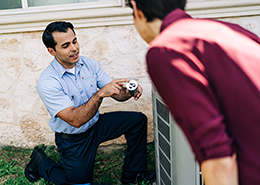
Aire Serv technician talking with a customer.

Why Your Air Conditioner Is Not Enough

An air conditioner removes moisture when warm, humid air passes across a coil cold enough to condense water out of it. That water drains away. Dehumidification is a byproduct of the cooling, and it only happens while the system is running.

That creates a structural gap in this climate.

Cooling demand and moisture demand do not track together. On a mild, humid day, the house does not need much cooling, so the system runs briefly and stops. The moisture load has not gone anywhere. The house ends up at the right temperature and the wrong humidity.

The gap is worst exactly when you notice it. Shoulder seasons, rainy stretches, evenings, and lightly occupied houses are all conditions with low sensible load and high latent load. Those are precisely when people describe their home as clammy.

Oversized equipment makes it worse. A system too large for the house reaches setpoint faster and runs less, which means less runtime, which means less moisture removal. This is why installing a bigger air conditioner to fix a humidity complaint reliably fails, and it is one of the most common mistakes in this market.

Overcooling is an expensive workaround. Setting the thermostat to 70 to feel comfortable is a way of buying runtime. It works, sort of, and you pay for it every month while never actually solving the moisture problem.

Dedicated dehumidification breaks the dependency. It removes moisture on its own schedule, independent of whether the house needs cooling.

Why Your Air Conditioner Is Not Enough
Aire Serv technician showing a customer something on their tablet device.

The Coastal Versus Inland Assumption Is Wrong

The biggest misunderstanding we correct is that beachfront homes are humid while inland homes are not. Outdoor humidity across this territory is broadly similar. Pensacola Beach, Gulf Breeze, Pace, and Milton all experience the same maritime moisture influence. Summer dew points routinely reach oppressive levels.

What actually determines indoor humidity is how tightly the home is built.

Post-2010 construction is where the problem often concentrates. Tighter envelopes, spray foam insulation, and impact-rated windows reduce unintended air exchange. That improves efficiency but leaves moisture from cooking, showers, laundry, and breathing with fewer ways out. New homes in Beulah, Pace, and Navarre can have worse indoor humidity than a leaky 1960s home near the water.

Older homes leak, and leaking provides some ventilation. Pre-2000 construction often exchanges air through gaps. It is inefficient, but that air movement can help remove moisture. Some older homes maintain acceptable humidity with the air conditioner alone.

Coastal properties face another issue: equipment corrosion. Salt can corrode outdoor coils, reducing capacity and dehumidification effectiveness. Combine that with tight, hurricane-resistant construction, and newer coastal homes can face both challenges at once.

Vacation and seasonal properties are especially vulnerable. Low occupancy means low cooling demand and less AC runtime, which means less dehumidification. A closed home can develop serious moisture problems before anyone notices.

The practical takeaway: measure, don't assume. Monitor indoor humidity during the cooling season. If it consistently stays above 60% while the AC runs, whole-home dehumidification may be worth considering—regardless of your address.

What Happens Above 60 Percent

Humidity targets are not comfort preferences. They are thresholds with consequences.

Mold. The EPA advises keeping indoor relative humidity below 60 percent specifically to limit mold growth. Mold does not need standing water. Sustained humidity against a surface is enough. Once it establishes in ductwork, wall cavities, or under flooring, you are into remediation rather than cleaning.

Dust mites. They require humidity to survive and their populations expand substantially above roughly 55 percent. Dust mite allergen is one of the most common indoor allergy triggers, and it is why some people feel worse at home than outside.

Materials. Sustained high humidity affects wood flooring, cabinetry, musical instruments, doors that stick seasonally, and the adhesives holding engineered products together.

Comfort at a given temperature. At high humidity, your body cannot shed heat through evaporation effectively, which is why 76 degrees at 50 percent humidity feels better than 72 at 70 percent. This is also the mechanism behind the energy argument below.

The target range is 45 to 55 percent. Below about 40 percent introduces different problems, including static and dried-out materials, though in this climate you will rarely get there accidentally.

Does It Save Money?

Partly, and we would rather explain the mechanism than hand you a payback number we cannot support.

The real saving comes from raising your thermostat. At 50 percent humidity, most people are comfortable several degrees warmer than they are at 70 percent, because their body can actually shed heat. Every degree you can raise the setpoint and still be comfortable reduces cooling runtime.

Whether that offsets the dehumidifier's own energy use depends on your house, your habits, and how far your humidity is currently off target. In a home where someone has been running 70 degrees to fight stickiness, the trade is often favorable. In a home already holding reasonable humidity, it will not be.

The larger financial case is usually avoidance rather than savings. Mold remediation, replacing warped flooring, and premature equipment replacement from a system running constantly all cost considerably more than humidity control. We are not going to quantify your specific payback, because anyone who does without measuring your house is guessing.

How Whole-Home Dehumidification Works

A whole-home unit ties into your duct system and operates on its own humidistat, independent of the thermostat calling for cooling.

Air is pulled across a cold coil inside the dehumidifier, moisture condenses and drains away through a dedicated or shared drain line, and drier air returns to the house. Because it runs on humidity rather than temperature, it works in exactly the conditions where your air conditioner cannot help: mild days, evenings, rainy stretches, and low-occupancy periods.

Compared to portable units: portables treat one room, require emptying or a drain, add heat to the space they are in, and lack the capacity for a whole house in this climate. They are a reasonable stopgap for a single problem room, not a solution.

Installation typically ties into existing ductwork and drainage. Configuration varies by house, including whether the unit is ducted to draw from and supply to the main trunk, dedicated to a problem zone, or set up to also provide filtered ventilation air. We size to your home's actual moisture load rather than square footage alone.

Controls matter more than people expect. A dehumidifier fighting an air conditioner, or a system where both are trying to control humidity independently, wastes energy and produces uneven results. Integrating the controls so cooling and dehumidification cooperate is part of doing this correctly.

Fix the Causes First

We would rather do less work and have it hold than sell you equipment that fights an ongoing moisture source forever.

Before recommending a dehumidifier, we look at:

Duct leakage. A leaking duct system in a hot attic pulls humid attic air directly into your supply. In newer construction, this is frequently the entire cause, and sealing it can resolve the problem without any new equipment. See duct sealing.

Crawl space moisture. Homes over vented crawl spaces have ground moisture evaporating underneath them. A leaky return duct under the house actively pulls that into the living space. A ground vapor barrier and duct sealing address the source.

Oversized cooling equipment. If your system is too large, it will never run long enough to dehumidify. Sometimes the correct answer is right-sizing at the next replacement rather than adding equipment now.

Bathroom and kitchen exhaust. Fans that vent into an attic instead of outside, or that were never used, put significant moisture into the house.

Condensate drainage. A drain pan holding standing water is a humidity and biological source sitting inside your air handler.

Uninsulated cold water lines, particularly on well systems and in crawl spaces, sweat continuously through humid months.

When we find one of these, we say so. A dehumidifier installed on top of an uncontrolled moisture source is a permanent operating cost instead of a fix.

Seasonal and Vacation Properties

This is where dehumidification stops being a comfort upgrade and becomes property protection.

A closed house in this climate with minimal cooling demand gets very little dehumidification, because the air conditioner has almost no reason to run. Meanwhile, the moisture load continues. Owners return to musty odors, mold on surfaces, and, in bad cases, remediation.

What works for a property that sits empty:

  • Hold a moderate temperature rather than shutting the system off entirely
  • Add dedicated dehumidification set to hold 50 percent, since it will run when the air conditioner will not
  • Use a thermostat or monitor with humidity reporting and remote alerts, so you find out about a failure while it is still a problem rather than a catastrophe
  • Verify condensate drainage before the property closes for the season

We work with property managers across Pensacola Beach, Perdido Key, Navarre Beach, and the Gulf Breeze peninsula on exactly this. See the Coastal Advantage Plan for the maintenance side.

Related Services

Dehumidification works alongside the rest of the system rather than in isolation.

  • Indoor air quality covers filtration and the broader picture
  • Fresh air ventilation matters because bringing outdoor air into a Gulf Coast home without addressing its moisture makes humidity worse, not better
  • Duct sealing is frequently the actual cause and the cheaper fix
  • AC maintenance keeps the coil clean, which directly affects how well your system dehumidifies
  • AC installation is where sizing gets corrected permanently
Written by the team at Aire Serv of Northwest Florida.
Technically reviewed by Justin B., NATE-certified and EPA 608 certified, 19 years in the trade.
Reviewed for accuracy by owner Justin Sonntag, a 26-year Gulf Coast resident.
Florida Certified Air Conditioning Contractor, license CAC1823566.

Last reviewed: August 2026

Questions about your system? Call or book online in about a minute.

The Aire Serv Advantage

From tune-ups and maintenance to heater repair and air conditioning replacement, we provide services that keep the air you breathe clean and keep your home or business at the perfect temperature.

Worry-Free HVAC Starts with Our Advantage Plan

Keep your system running smoothly with expert care you can count on.

Aire Serv of Northwest Florida

  • Avalon
  • Bellview
  • Brent
  • Cantonment
  • Chumuckla
  • Cordova Park
  • Dickerson City
  • East Milton
  • Ensley
  • Ferry Pass
  • Floridatown
  • Garcon Point
  • Gonzalez
  • Goulding
  • Gulf Breeze
  • Harold
  • Holley
  • Milton
  • Myrtle Grove
  • Navarre
  • Navarre Beach
  • Oriole Beach
  • Pace
  • Pea
  • Pensacola
  • Roeville
  • Tangen Heights
  • Tiger Point
  • Wallace
  • Woodlawn Beach

Dehumidification Questions

  • Because cooling and dehumidifying are separate jobs and only one of them is happening reliably. Your air conditioner removes moisture only while it runs, as a side effect of cooling. When the house does not need much cooling but the air is still full of moisture, which describes mild days, evenings, rainy stretches, and lightly occupied homes, the system satisfies the thermostat quickly and shuts off before removing much water. If your system is oversized, this is worse, because it reaches setpoint even faster and runs even less. The fix is either dedicated humidity control, right-sizing at the next replacement, or equipment that can run longer at lower output. Adding a bigger air conditioner makes it worse.

Worry-Free HVAC Starts with Our Advantage Plan

Keep your system running smoothly with expert care you can count on.

Schedule Online

By checking this box, I agree to opt in to receive automated SMS and/or MMS messages from Aire Serv, a Neighborly company, and its franchisees to the provided mobile number(s). Messages & data rates may apply. Message frequency varies. View Terms and Privacy Policy. Reply STOP to opt out of future messages. Reply HELP for help.

By entering your email address, you agree to receive emails about services, updates or promotions, and you agree to the Terms and Privacy Policy. You may unsubscribe at any time.