Skip to Main Content Skip to Footer Content

Heat Pump Repair in Pensacola, FL

Your Neighbors. Your Comfort.

Most homes here rely on heat pumps for year-round comfort, making reliable repairs essential when problems arise. Heat pumps cool in summer and heat in winter, using reversing valves, defrost controls, and backup heat that require expertise. We repair all major brands, whether we installed them or not. 

You'll always receive upfront, by-the-job pricing, plus honest repair-or-replace guidance so you make the best decision for your home.

Call or schedule service online.

Heat Pump Repair in Pensacola, FL
Your Neighbors. Your Comfort.
Two heat pump exterior outdoor units.

Let Us Call You

By checking this box, I agree to opt in to receive automated SMS and/or MMS messages from Aire Serv, a Neighborly company, and its franchisees to the provided mobile number(s). Messages & data rates may apply. Message frequency varies. View Terms and Privacy Policy. Reply STOP to opt out of future messages. Reply HELP for help.

By entering your email address, you agree to receive emails about services, updates or promotions, and you agree to the Terms and Privacy Policy. You may unsubscribe at any time.

  • This is the call we take most during a cold snap, so it is worth understanding before you dial.

    Heat pump supply air is cooler than furnace air by design. A furnace delivers air well over 100 degrees. A heat pump typically delivers air in the mid to high 90s, which is warmer than your room and will heat the house, but it can feel cool against your hand. Homeowners moving from a furnace frequently report this as a problem when it is simply how the equipment works.

    Also normal: during a defrost cycle the system briefly runs in reverse to melt frost off the outdoor coil. You may see steam outside and feel cooler air indoors for several minutes. If it clears within about ten minutes, that was defrost doing its job.

    Actually a problem: air that is genuinely cold rather than merely cooler, an outdoor unit encased in ice that does not clear, or a house steadily losing temperature while the system runs. Those point to a stuck reversing valve, a failed defrost control, low refrigerant charge, or backup heat that is not engaging.

    Worth trying before you call: switch the thermostat to emergency heat. That bypasses the heat pump and runs the backup strips directly. If you get real warmth, the problem is isolated to the heat pump side and you have a way to stay warm overnight. If you get nothing, backup heat is involved too. Either answer makes the visit faster and cheaper.

  • Northwest Florida gets somewhere between three and eight genuinely cold nights a year. That is exactly what makes heating failures worse here rather than better.

    Your electric resistance backup heat strips, along with their sequencers and relays, sit unused for eight or nine months. They fail during that dormancy without announcing it. The system continues to appear functional, because the heat pump alone handles mild weather fine and nothing ever calls on the backup.

    Then a freeze arrives. The heat pump loses capacity as outdoor temperature drops, backup does not engage, and the house will not get warm. Because every home in the county discovers this in the same forty-eight hours, every HVAC company in both counties is oversubscribed at the same moment.

    The January 2025 cold snap made this visible across the region. Homes with systems that appeared to be working could not maintain temperature, and the cause in most cases was not the heat pump.

    There is a second version of the same problem that costs money rather than comfort. If the auxiliary lockout temperature is set too high, expensive resistance heat runs during mild weather when the heat pump could carry the load alone. That is a configuration setting, frequently a free fix, and it shows up as a January electric bill that alarms people.

    Test your heat in September or October. 15 minutes and a switch to emergency heat tells you where you stand.

  • If you own on Pensacola Beach, Perdido Key, the Gulf Breeze peninsula, Navarre Beach, or the Pensacola bayfront, your repair history looks different from an inland neighbor's, and there is a specific reason.

    Salt corrodes the outdoor coil, reducing the fin surface available to move heat. Less surface means the refrigerant condenses at a higher temperature and the compressor works against higher pressure, which cuts capacity and increases wear. Salt also corrodes electrical terminals and contactor surfaces while holding moisture against them. Corroded connections carry higher resistance, resistance generates heat, and heat is what kills capacitors and contactors.

    So coastal properties see two things at once: more frequent small electrical failures, and earlier major ones.

    If you have replaced the same part repeatedly on a beach or peninsula property, corrosion is almost certainly why, and replacing it again does not address it. When we diagnose a coastal heat pump we assess coil and hardware condition as part of the visit rather than only the failed component, because on a heavily corroded system the part you are replacing is a symptom rather than the cause.

    That assessment also tells you something useful about timing. A coil corroding through is a replacement conversation you want to have in October rather than in July.

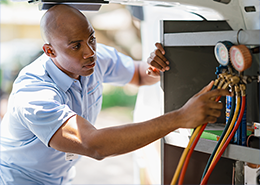
Aire Serv technician working on the heat pump unit.

What Goes Wrong With Heat Pumps Here

Reversing valve failure. The reversing valve switches your system between heating and cooling, and failures can leave you with cold air in winter or warm air in summer. Accurate diagnosis is key to avoiding unnecessary repair costs.

Defrost control problems. During heating mode, frost can build up on the outdoor coil, so your heat pump automatically enters defrost mode to melt it. If the defrost system fails, ice can cover the unit and reduce heating performance, often going unnoticed until cold weather arrives.

Auxiliary heat failures. As temperatures drop, heat pumps rely on electric backup heat. They can fail without warning; it's one of the most common cold-weather heat pump issues, making fall maintenance important.

Auxiliary lockout set wrong.  A configuration issue rather than a failure. Set too low and backup never engages when you need it. Set too high and it runs constantly in mild weather, producing an electric bill that alarms people. Frequently the fix is free and the diagnosis is the whole job.

Capacitors and contactors.  The most common failure overall. Capacitors give the compressor and fan motors the push to start. Contactors switch the outdoor unit. Both wear with heat and runtime, and on coastal properties corroded electrical connections accelerate both considerably.

Refrigerant loss. Even a small refrigerant loss can reduce heating. Adding refrigerant is only a temporary fix if there's a leak, so we always identify and address the source of the problem whenever possible.

Compressor failure. Expensive, and usually the end of a long process. Frequently preceded by months of running against elevated head pressure from a dirty or corroded outdoor coil.

Coastal electrical corrosion. On coastal properties, salty air accelerates corrosion of electrical connections and components, damaging them. If the same parts keep failing, corrosion is often why.

What Goes Wrong With Heat Pumps Here
Heat pump outdoor unit.

Blowing Cold Air in Heating Mode

This is the call we get most during a cold snap, so it is worth understanding the sorting before you dial.

Normal, not a failure: heat pump supply air is cooler than furnace supply air. A furnace delivers air well over 100 degrees. A heat pump typically delivers air in the mid to high 90s, which is warmer than the room but can feel cool against your hand. Many homeowners new to heat pumps report a problem that is simply how the equipment works.

Also normal: during a defrost cycle the system briefly runs in reverse, and you may see steam off the outdoor unit and feel cooler air indoors for several minutes. If it clears on its own within about ten minutes, that was defrost doing its job.

Actually a problem:  air that is genuinely cold rather than merely cooler, the outdoor unit encased in ice that does not clear, or the house steadily losing temperature while the system runs. Those point to a stuck reversing valve, a failed defrost control, low charge, or backup heat that is not engaging.

Worth trying before you call: switch the thermostat to emergency heat. That bypasses the heat pump and runs the backup strips directly. If you get real heat, you have narrowed the problem to the heat pump side and you have a way to stay warm overnight. If you get nothing, the backup heat is also involved. Either answer makes our visit faster and cheaper.


Repair or Replace

We will give you both numbers rather than one.

Repair generally makes sense when:

  • The system is under about ten years old
  • One component failed and the rest of the system is sound
  • The refrigerant is current generation and readily available
  • The outdoor coil is in reasonable condition, meaning not heavily corroded on a coastal property.

Replacement deserves serious consideration when:

  • The system is fifteen years or older, and especially at twenty-plus
  • The failure is a compressor, a reversing valve, or an evaporator coil, which are the three big-ticket components
  • The system uses R-22, which is no longer produced and expensive to source, making every future repair worse than the last
  • The outdoor coil is corroded to the point that capacity is already reduced, which is common on the coast
  • You have had multiple repairs in the past two seasons

The specific case worth naming:  a reversing valve failure on a system past fifteen years.  The valve is a major component, the labor is significant, and you are investing heavily in equipment whose remaining life is limited. That is the point where we run the replacement number alongside it and let you decide with real figures rather than pressure.

Refrigerant transition context. Systems built through 2024 generally use R-410A. New equipment now uses R-454B or R-32. R-410A is not disappearing overnight, but it is in phase-down, and cost and availability move in one direction over the life of an aging system. If your equipment predates R-410A and uses R-22, that is already a strong replacement signal on its own.


Diagnostics We Actually Perform

A diagnosis is not putting a hand in front of a vent.

  • Refrigerant pressures on both sides, with superheat and subcooling calculated rather than estimated
  • Static pressure to determine whether the duct system is restricting the equipment
  • Amp draw on the compressor and fan motors against nameplate specification
  • Capacitor values measured under load against rated specification, not a pass-fail glance
  • Contactor contact condition
  • Supply and return temperature split
  • Reversing valve operation in both modes
  • Defrost cycle initiation and termination
  • Every stage of auxiliary heat, individually
  • Thermostat configuration including auxiliary lockout setpoint
  • Incoming voltage under running load, which matters particularly on rural properties where distribution runs are long.

You get a written summary of what we found, what we did, and what we are watching.


Coastal Heat Pumps

On Pensacola Beach, Perdido Key, the Gulf Breeze peninsula, Navarre Beach, and the Pensacola bayfront, heat pumps face a problem inland systems do not.

Salt corrodes the outdoor coil, which reduces the surface area available to move heat. That raises operating pressures, cuts capacity, and increases the load on the compressor. It also corrodes electrical terminals, which is the mechanism behind the repeated capacitor and contactor failures coastal homeowners come to accept as normal.

When we diagnose a coastal heat pump we assess coil condition as part of the visit rather than only addressing the failed part, because on a heavily corroded system the part you are replacing is a symptom. See the Coastal Advantage Plan for the protection side of this.


Fall Testing, and Why It Matters More Here

Northwest Florida gets somewhere between three and eight genuinely cold nights a year. That is exactly what makes heating failures worse rather than better.

Your backup heat strips, sequencers, and relays sit unused for eight or nine months. They fail during that period without announcing it. The system continues to appear functional, because the heat pump alone handles mild weather fine. Then a freeze arrives, the heat pump cannot carry the load alone, backup does not engage, and the house will not get warm.

Because everyone discovers this in the same 48 hours, every HVAC company in both counties is oversubscribed simultaneously.

Test your heat in September or October. Run it for 15 minutes, confirm you get genuine warmth, and switch to emergency heat briefly to confirm backup works. Or schedule a fall maintenance visit, where we test each stage of auxiliary heat individually rather than confirming that something warm comes out. That is included in both the Advantage Plan and Coastal Advantage Plan.


Related Services


Written by the team at Aire Serv of Northwest Florida.
Technically reviewed by Justin B., NATE-certified and EPA 608 certified, 19 years in the trade.
Reviewed for accuracy by owner Justin Sonntag, a 26-year Gulf Coast resident.
Florida Certified Air Conditioning Contractor, license CAC1823566.

Last reviewed: August 2026

Questions about your system? Call or book online in about a minute.

The Aire Serv Advantage

From tune-ups and maintenance to heater repair and air conditioning replacement, we provide services that keep the air you breathe clean and keep your home or business at the perfect temperature.

Worry-Free HVAC Starts with Our Advantage Plan

Keep your system running smoothly with expert care you can count on.

Aire Serv of Northwest Florida

  • Avalon
  • Bellview
  • Brent
  • Cantonment
  • Chumuckla
  • Cordova Park
  • Dickerson City
  • East Milton
  • Ensley
  • Ferry Pass
  • Floridatown
  • Garcon Point
  • Gonzalez
  • Goulding
  • Gulf Breeze
  • Harold
  • Holley
  • Milton
  • Myrtle Grove
  • Navarre
  • Navarre Beach
  • Oriole Beach
  • Pace
  • Pea
  • Pensacola
  • Roeville
  • Tangen Heights
  • Tiger Point
  • Wallace
  • Woodlawn Beach

Heat Pump Repair Questions

  • Start by distinguishing cool from cold. Heat pump supply air runs cooler than furnace air by design, typically in the mid to high 90s, which is warmer than your room but can feel cool against your hand. If it is genuinely cold, the likely causes are a stuck reversing valve leaving the system in cooling mode, a defrost cycle stuck on, low refrigerant charge, or a thermostat wiring problem with the reversing valve control. Try switching the thermostat to emergency heat. If you get real warmth, the problem is on the heat pump side and you have a way to stay warm overnight. If you get nothing, backup heat is involved too. Either answer makes the repair visit faster.

Worry-Free HVAC Starts with Our Advantage Plan

Keep your system running smoothly with expert care you can count on.

Schedule Online

By checking this box, I agree to opt in to receive automated SMS and/or MMS messages from Aire Serv, a Neighborly company, and its franchisees to the provided mobile number(s). Messages & data rates may apply. Message frequency varies. View Terms and Privacy Policy. Reply STOP to opt out of future messages. Reply HELP for help.

By entering your email address, you agree to receive emails about services, updates or promotions, and you agree to the Terms and Privacy Policy. You may unsubscribe at any time.