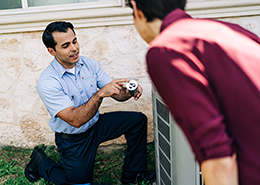
Every visit runs the same 22-step workflow, in the same order, with photographs captured at fixed points and readings recorded against nameplate specifications.
The system also has to pass a hard operational check early in the visit before any maintenance proceeds. If it fails, the visit diverts to diagnostics rather than continuing, because cleaning a coil on a system with an unresolved fault produces a well-maintained machine that still does not work.
Outdoor unit
- Clean the condenser coil, which in this region means pollen, debris, and salt deposits on coastal properties
- Check refrigerant charge and adjust as needed
- Load test start and run capacitors rather than eyeballing them
- Inspect and tighten electrical connections, apply dielectric grease
- Evaluate compressor operation under load, including amp draw
- Verify airflow across the coil, check fan blade and motor condition
- Test contactor operation and flag pitted contacts before they fail
- Level the unit if the pad has settled and verify anchoring
Indoor unit
- Replace or clean the air filter
- Clean the evaporator coil where accessible
- Check blower motor operation
- Inspect the blower wheel for buildup
- Measure static pressure to verify airflow
- Check refrigerant line insulation for damage
- Inspect the drain pan for rust, damage, and biological buildup
- Verify condensate drainage, treat the line, and confirm the float safety switch works
System performance
- Test thermostat accuracy, calibration, and programming
- Measure supply and return air temperature split
- Verify superheat and subcooling
- Test defrost control on heat pumps and verify safety switches
- Evaluate dehumidification performance, which in this climate is often the real comfort issue
- Check cycling behavior and runtime
- Compare overall performance against manufacturer specifications
- Document findings and provide a written report
Most visits run 60 to 90 minutes. You get a written report with the findings and the photographs from the visit.
Why Twice a Year Here
Spring, before cooling season. The system is about to carry six months of load. Coil condition, charge, capacitor values, and drain condition all determine whether it does that efficiently or expensively.
Fall, before heating season. This is the visit people skip and the one that catches the failures that hurt most. In Northwest Florida, heating equipment and heat pump backup heat strips sit unused for eight or nine months. They fail silently during that time. The system continues to appear functional because the heat pump alone handles mild weather fine. Then a freeze arrives, backup does not engage, and the house will not warm up, along with every other house in the county in the same 48 hours.
The fall visit tests each stage of auxiliary heat individually rather than confirming that something warm comes out of a vent. On gas and propane equipment, it includes combustion safety, heat exchanger inspection, and venting, none of which is optional on a fuel-burning appliance.
Coastal properties need the outdoor unit attended to more than twice a year for salt, which is why the Coastal Advantage Plan adds salt flushing, corrosion treatment, and hardware inspection to both visits.
Maintenance and Your Warranty
Most manufacturer warranties condition coverage on documented professional maintenance, and many also require registration within a set window after installation. Both are commonly discovered only when a claim is denied.
We register equipment we install and keep service records you can retrieve. If you are unsure of your terms, we can usually identify them from your model and serial number during a visit.
Two things worth knowing that most homeowners do not. Registration windows are short, commonly 60 days after installation, and missing one drops the equipment from the longer registered parts term to the shorter base term. And where installation paperwork no longer exists, manufacturer terms commonly default the effective warranty date to the manufacture date encoded in the serial number plus a grace period, so an undocumented system inherited with a house is not automatically uncovered. Capturing your dataplates is how we establish which situation you are in. The full warranty argument, including why this is often the single largest financial reason to maintain equipment, is on the Advantage Plan page.
What Maintenance Does Not Do
We would rather set expectations accurately than oversell.
It does not prevent every failure. Components fail. What maintenance does is catch a meaningful share of them while they are still small, particularly capacitors drifting out of specification, contactors pitting, and drains partially restricting.
It does not fix a design problem. If your system is oversized, or your ducts are undersized or leaking, a tune-up will not resolve the resulting humidity or comfort complaint. It will tell you that is what is happening, which is worth knowing, but the fix is duct sealing, dehumidification, or right-sizing at replacement.
It does not extend equipment life indefinitely. A well-maintained system reaches the end of its life later than a neglected one. It still reaches it.
It is a weaker purchase on very old equipment. On a system near the end of its life and out of warranty, we will say so rather than selling you a plan. See the Advantage Plan page for where that line falls.
Between Visits
Call us if you notice any of these rather than waiting for the next scheduled service:
- Weak airflow from registers
- Warm air with the system in cooling mode
- A house that feels clammy while the system runs, which is a humidity issue rather than a cooling one
- Water pooling near the indoor unit, or any water where water should not be
- Ice on refrigerant lines or the indoor coil
- New noise, particularly grinding, squealing, or repeated clicking
- Short cycling, meaning frequent on and off without reaching setpoint
- A bill that jumped without a change in habits
- A musty smell when the system starts
Filter checks are monthly here, not on the interval printed on the box. Pollen is heavy across the region, construction dust is significant in growing subdivisions, and rural properties on unpaved roads load faster still.
The Advantage Plan
Both maintenance visits, priority scheduling, and 15 percent off repairs and diagnostic labor are included with the membership. The Advantage Plan is $249 a year or $25.99 a month. For properties in direct salt exposure, the Coastal Advantage Plan is $349 a year or $34.99 a month and adds a Salt-Away coil flush with matched before and after photos, dielectric grease and Boeshield T-9 on electrical connections and exposed hardware, an annual DiversiTech Coil Guard protective coating on spring visits, ceramic cabinet protection, and a corrosion monitoring photo shot from the same angle every year.
We will tell you which tier fits your address rather than defaulting to the higher one. Inland homes in Pace, Milton, Cantonment, and Beulah do not need the coastal package.
Related Services
- AC repair when something has already failed
- Emergency HVAC service for after-hours situations
- Duct cleaning and duct sealing
- Whole-home dehumidification when the complaint is moisture rather than temperature
- Indoor air quality improvements
- Furnace repair for combustion safety checks on gas and propane equipment
Written by the team at Aire Serv of Northwest Florida.
Technically reviewed by Justin B., NATE-certified and EPA 608 certified, 19 years in the trade.
Reviewed for accuracy by owner Justin Sonntag, a 26-year Gulf Coast resident.
Florida Certified Air Conditioning Contractor, license CAC1823566.
Last reviewed: August 2026
Questions about your system? Call or book online in about a minute.