Skip to Main Content Skip to Footer Content

Air Conditioner Repair in Pensacola, FL

Pensacola air conditioners work harder than almost anywhere else, running from roughly May through October. A system in Pensacola accumulates run hours a comparable system in Atlanta never sees. That extra wear means small issues like dirty coils or low refrigerant can quickly become bigger problems.

We diagnose with the right tools, not guesswork, and if a repair isn't the best investment, we'll explain your options. We charge by the job, not the hour, so you know the cost upfront.

Air Conditioner Repair in Pensacola, FL
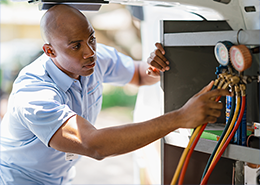
Aire Serv technician working on a customer's air conditioning unit.

Let Us Call You

By checking this box, I agree to opt in to receive automated SMS and/or MMS messages from Aire Serv, a Neighborly company, and its franchisees to the provided mobile number(s). Messages & data rates may apply. Message frequency varies. View Terms and Privacy Policy. Reply STOP to opt out of future messages. Reply HELP for help.

By entering your email address, you agree to receive emails about services, updates or promotions, and you agree to the Terms and Privacy Policy. You may unsubscribe at any time.

  • The capacitor is the single most common failure we see, and it is the one most likely to be replaced twice. It stores the electrical charge that gets your compressor and fan motors turning, and it degrades with heat and runtime. Our cooling season runs from roughly May through October, so equipment here accumulates far more operating hours than the same unit installed in a shorter-season climate, and capacitors wear accordingly.

    What separates a coastal property from an inland one is not the capacitor itself. It is what sits around it. Salt is both corrosive and hygroscopic, meaning it draws moisture out of the air and holds it against metal terminals. Corroded connections carry higher resistance, resistance produces heat, and heat is what shortens a capacitor's life. That is the mechanism behind the repeated small electrical failures homeowners on Pensacola Beach, the Gulf Breeze peninsula, and the bayfront come to accept as normal.

    So when we find a failed capacitor on a coastal system, we test the value under load against the nameplate rating rather than pass-fail, inspect the contactor for pitting, and check the terminals for corrosion. Replacing the part without addressing why it failed produces the same call next summer. If you have replaced two or more in a few seasons, the honest answer is that something upstream is causing it, and finding that is the actual repair.

Aire Serv technician working on a customer's air conditioning unit.

Condensate Drains, and How a Small Blockage Puts Water Through Your Ceiling

Your air handler produces a substantial volume of water during normal cooling operation. In a climate this humid, it produces more of it, for more months of the year, than almost anywhere in the country. That water has to leave the building through a drain line, and warm standing water in a dark line grows biology quickly.

When the line blocks, the pan overflows. If your air handler is in an attic, the overflow goes into your ceiling.

There should be a float safety switch that shuts the system down before that happens. In our experience, they are missing about as often as they are present, and when present, they are frequently untested. That single component is the difference between a system that stops cooling and a system that ruins drywall.

This failure is almost entirely preventable, which is the frustrating part. Clearing the line and verifying the safety switch takes minutes on a scheduled maintenance visit. Discovering the blockage after water has traveled through insulation and drywall is a repair, a ceiling, and sometimes a mold conversation.

If you see water anywhere near your indoor unit, or if the system shut itself off with no other symptom, turn it off to stop producing more water and call. A blank thermostat with a dead system is frequently a float switch doing exactly its job.

When the House Is Cool and Still Feels Wrong

Cooling and dehumidifying are two separate jobs. Your AC removes moisture only as a side effect of cooling, and only while running. On a mild humid day or evening, the system reaches the thermostat setpoint quickly and shuts off before it has pulled much water out of the air.

An oversized system makes this worse rather than better, because it reaches setpoint faster and runs less. That is why installing a larger unit to fix a humid house reliably fails, and it is one of the most common and most expensive mistakes made in this market.

When we diagnose a comfort complaint, we measure indoor relative humidity, not just temperature. If your humidity is the problem, the answer is dedicated dehumidification, sealing duct leakage that is importing humid attic air, or correcting the sizing at your next replacement. None of those is a repair to your air conditioner, and we will say so on the visit rather than replacing a part that changes nothing.

One variable worth checking yourself first. If your thermostat fan is set to ON rather than AUTO, water that condensed on the coil is being blown back into the house before it can drain. That setting alone can add several points of relative humidity, and correcting it costs nothing.

What Actually Fails Here

Capacitors. The most common failure. The symptom is usually a system that hums without starting, or an outdoor fan that won’t spin. Corroded electrical connections accelerate this considerably, so beach and peninsula homeowners replace capacitors more often than inland ones.

Contactors. They control the outdoor unit. Contacts pit and burn with every cycle, and over a long season that adds up. The symptom is often a fan running with no cooling, or an audible clicking. Frequently visible as pitting during a maintenance inspection well before it fails outright.

Condensate drain blockage. Very common,as high humidity means an air handler produces a substantial volume of water and warm stagnant water grows mold quickly. The line blocks, and either a float switch shuts the system down or, if one is missing or failed, water goes into your ceiling, and is preventable with routine service.

Frozen evaporator coil. Caused by restricted airflow from a dirty filter coil, or by low refrigerant charge. Freezing is a symptom, not a cause, so the repair has to address why it froze.

Refrigerant leaks. Vibration, corrosion, and pinholing in copper tubing all produce leaks. Corrosion-driven leaks are more common on coastal properties. Adding refrigerant without locating the leak is treating a symptom, and we will tell you that rather than selling you a recharge every summer.

Fan motors. Indoor and outdoor. Long seasons and high loads wear bearings and windings. Symptom is no airflow, overheating, or new noise.

Thermostat: Sometimes the whole problem, sometimes a red herring. Failed sensors, dead batteries, wiring faults, and on smart thermostats, humidity sensor failures that produce strange behavior.

Compressors. Expensive, and usually the end of a long process rather than a sudden event. Frequently preceded by months of running against elevated pressure from a dirty or corroded condenser coil.

What Actually Fails Here
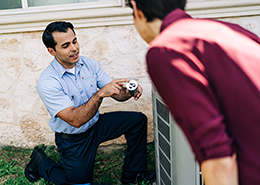
Aire Serv technician talking with a client in front of an air conditioning unit.

Cooling but Still Humid Is Not a Repair Problem

This is important enough to separate from the failure list, because we get called for it constantly and it is usually not a broken air conditioner.

If your house reaches the thermostat setpoint and still feels sticky, the system is doing one of its two jobs. Cooling and dehumidifying are separate functions. Your air conditioner removes moisture as a byproduct of cooling, only while it runs. When the house does not need much cooling but the air is still saturated, the system satisfies the thermostat quickly and shuts off before removing much water.

An oversized system makes this worse, not better, because it reaches setpoint faster and runs less.

The fix is usually not a repair. It is dedicated whole-home dehumidification, correcting duct leakage that is importing humid attic air, or right-sizing at the next replacement. We measure indoor relative humidity during diagnostics rather than treating every comfort complaint as a temperature problem. If that is what is happening in your house, we will tell you so instead of selling you a repair that will not change anything.

How We Diagnose

A diagnosis is not putting a hand in front of a vent and replacing the part that usually fails.

  • Refrigerant pressures on both sides, with superheat and subcooling calculated
  • Static pressure, which tells us whether the duct system is choking the equipment
  • Amp draw on compressor and fan motors against nameplate
  • Capacitor values measured under load against rated specification, not a pass-fail glance
  • Contactor contact condition
  • Supply and return temperature split
  • Indoor relative humidity
  • Condensate drain and pan condition, and whether the float safety switch works
  • Coil condition, indoor and outdoor
  • Incoming voltage under running load, which matters on rural properties where distribution runs are long

You get a written summary of what we found, what we did, and what we are watching. When we can show you a failed component, we do.

Repair or Replace, With Real Numbers

We give you both figures and the reasoning, then get out of the way.

Repair generally makes sense when:

  • The system is under about 10 years old
  • One component failed, and the rest is sound
  • The refrigerant is current generation and readily available
  • The outdoor coil is in reasonable condition
  • This is the first significant repair in recent memory

Replacement deserves serious consideration when:

  • The system is fifteen years or older
  • The failure is a compressor or an evaporator coil, the two big-ticket items
  • The system uses R-22, which is no longer produced and expensive to source, meaning every future refrigerant repair gets worse than the last
  • The outdoor coil is corroded enough that capacity is already reduced, which is common on coastal properties
  • You have had multiple service calls in the past two seasons
  • The system has never controlled humidity well, which usually means it was oversized at installation and no repair changes that

On refrigerant specifically. Systems built through roughly 2024 generally use R-410A. New equipment uses R-454B or R-32. R-410A is in phase-down, so cost and availability move in one direction over the remaining life of an aging system. Equipment using R-22 predates all of it and is a strong replacement signal on its own.

What we will not do is quote you a compressor on a twenty-year-old system without also quoting the replacement, or push replacement on a nine-year-old system with one failed capacitor.

Coastal Repair Patterns

If you own on Pensacola Beach, Perdido Key, the Gulf Breeze peninsula, Navarre Beach, or the Pensacola bayfront, your repair history looks different, and there is a reason.

Salt corrodes the outdoor coil, which reduces the surface available to reject heat. That raises operating pressures, cuts capacity, and increases the load on the compressor. Salt also corrodes electrical terminals and contactor surfaces while holding moisture against them, and corroded connections generate heat, which is what kills capacitors and contactors.

So coastal properties see both more frequent small electrical failures and earlier major ones. If you are replacing the same parts repeatedly, corrosion is almost certainly why, and replacing the part again does not address it.

When we diagnose a coastal system, coil and hardware condition are part of the assessment rather than an afterthought.

Worth correcting a common assumption: inland properties in Pace, Milton, Cantonment, and Beulah face the same humidity as the coast, because the whole territory sits within roughly 25 miles of the Gulf. What they do not face is salt. Drainage problems, filter loading, and biological growth are region-wide. Corrosion is coastal.

Parts, Timing, and What to Expect

We stock common failure parts on the truck, which means capacitors, contactors, many control components, and standard motors can frequently be handled on the first visit.

Major components, compressors, coils, and some brand-specific parts, are ordered. When that happens, we tell you a realistic timeline rather than an optimistic one, and where possible we restore partial function while parts ship.

Every repair is tested before we leave, including verifying that the system is actually managing humidity rather than just producing cold air. Parts and labor carry a warranty, documented for your records.

Advantage Plan and Coastal Advantage Plan members receive priority scheduling and 15 percent off repairs and diagnostic labor.

Related Services

Call or schedule online. For after-hours situations, see our emergency HVAC services

Written by the team at Aire Serv of Northwest Florida.
Technically reviewed by Justin B., NATE-certified and EPA 608 certified, 19 years in the trade.
Reviewed for accuracy by owner Justin Sonntag, a 26-year Gulf Coast resident.
Florida Certified Air Conditioning Contractor, license CAC1823566.

Last reviewed: August 2026

Questions about your system? Call or book online in about a minute.

The Aire Serv Advantage

From tune-ups and maintenance to heater repair and air conditioning replacement, we provide services that keep the air you breathe clean and keep your home or business at the perfect temperature.

Worry-Free HVAC Starts with Our Advantage Plan

Keep your system running smoothly with expert care you can count on.

Aire Serv of Northwest Florida

  • Avalon
  • Bellview
  • Brent
  • Cantonment
  • Chumuckla
  • Cordova Park
  • Dickerson City
  • East Milton
  • Ensley
  • Ferry Pass
  • Floridatown
  • Garcon Point
  • Gonzalez
  • Goulding
  • Gulf Breeze
  • Harold
  • Holley
  • Milton
  • Myrtle Grove
  • Navarre
  • Navarre Beach
  • Oriole Beach
  • Pace
  • Pea
  • Pensacola
  • Roeville
  • Tangen Heights
  • Tiger Point
  • Wallace
  • Woodlawn Beach

AC Repair Questions

  • It depends on which component failed, how accessible the equipment is, and whether parts and refrigerant are readily available for your model. A capacitor is a minor repair. A compressor or evaporator coil is a major one. Attic air handlers and elevated coastal equipment take longer than a ground-level closet, and that is reflected honestly rather than hidden. We provide upfront pricing before any work begins and charge by the job rather than by the hour. Advantage Plan members receive 15 percent off repairs and diagnostic labor. When the AC repair is large enough that replacement deserves consideration, we quote both.

Worry-Free HVAC Starts with Our Advantage Plan

Keep your system running smoothly with expert care you can count on.

Schedule Online

By checking this box, I agree to opt in to receive automated SMS and/or MMS messages from Aire Serv, a Neighborly company, and its franchisees to the provided mobile number(s). Messages & data rates may apply. Message frequency varies. View Terms and Privacy Policy. Reply STOP to opt out of future messages. Reply HELP for help.

By entering your email address, you agree to receive emails about services, updates or promotions, and you agree to the Terms and Privacy Policy. You may unsubscribe at any time.