Ignition system. Modern furnaces use a hot surface ignitor or an intermittent pilot rather than a standing pilot light. Hot surface ignitors are a wear item and they fail, usually with the furnace attempting to start, clicking, and then locking out.
Flame sensor. It accumulates a film over time and stops sensing correctly, at which point the furnace lights and then shuts down within seconds, repeatedly. Cleaning or replacing it is minor work, and it is a very common cause of a furnace that appears to be trying and failing.
Gas valve. Controls fuel delivery. Failures are less common than ignition components but more significant, both in cost and because a gas valve is a safety device.
Pressure switch. Confirms the draft inducer is moving combustion gases out before allowing ignition. Failures often trace to a blocked flue, a disconnected or cracked hose, or condensate backing up in the drain. Replacing the part without finding the cause misses the actual problem, which may be a venting issue.
Draft inducer motor. Moves combustion products out through the flue. Failure prevents the furnace from firing at all, which is the correct safety behavior.
Limit switches. Shut the furnace down on overheat. Repeated limit trips usually indicate restricted airflow from a loaded filter, a dirty blower wheel, or closed and blocked registers, rather than a bad switch. Bypassing a limit switch is dangerous and we won’t do it.
Heat exchanger. A cracked heat exchanger allows combustion products including carbon monoxide into the supply air. This is the failure that ends a furnace's life, because a cracked exchanger is a condemn-and-replace situation rather than a repair on nearly all residential equipment.
Blower motor. Moves conditioned air through the house. Shared with the cooling side, so a blower failure takes out both heating and cooling.
Short Cycling, and Why It Is Not Just Annoying
A furnace that fires, runs briefly, shuts down, and restarts repeatedly is not merely inefficient. It is usually a safety control doing its job in response to a real condition.
Common causes:
Dirty flame sensor. The most frequent and the least serious. The furnace lights, fails to confirm flame, and shuts down within seconds. Cleaning usually resolves it.
Restricted airflow. A loaded filter, a dirty blower wheel, or closed registers cause the furnace to overheat and trip its limit switch. The fix is airflow, not the switch.
Oversizing. A furnace too large for the house satisfies the thermostat rapidly and shuts down before completing a proper cycle. In Northwest Florida, where the heating load is genuinely small, oversized furnaces are common because equipment was matched to the cooling requirement or simply replaced in kind without a load calculation.
Blocked flue. Restricted venting trips the pressure switch. Debris, nesting, or a partially blocked termination are all possibilities, and this one is a combustion safety issue rather than a nuisance.
We diagnose the cause rather than replacing the part that tripped.
Gas Versus Propane
Mechanically similar, meaningfully different in the details. Natural gas and propane burn at different pressures and require different orifice sizing. Equipment is manufactured for one and converted to the other with a manufacturer conversion kit. A conversion done incorrectly, or done with improvised parts, produces improper combustion, which means soot, wasted fuel, and potentially carbon monoxide.
Propane is common on rural properties beyond gas service, which in our territory means much of the area around Milton, north Santa Rosa County, and the outer parts of Cantonment and Pace. Natural gas availability varies by address, delivered by municipal and district providers in the more developed areas.
If you are buying a home with a converted appliance, or you inherited equipment of unknown history, it is worth having the conversion verified rather than assumed. We check orifice sizing and manifold pressure against the equipment's rating plate as part of a combustion check.
Repair or Replace
Replace, effectively without debate, when the heat exchanger is cracked. On residential equipment this is not repairable. A cracked exchanger permits combustion products into your supply air and the unit should be shut down and replaced.
Repair usually makes sense when:
- The furnace is under about twelve years old
- The failure is an ignitor, flame sensor, pressure switch, or inducer motor
- The heat exchanger and burners are in sound condition
- The unit was correctly sized and installed to begin with
Replacement deserves consideration when:
- The furnace is fifteen years or older
- The failure is a gas valve or a control board on an aging unit
- There have been multiple repairs in recent seasons
- The furnace is clearly oversized and short cycling because of it
- Combustion or venting problems keep recurring
One Northwest Florida specific consideration. Because our heating season is so short, a furnace here accumulates very few run hours per year compared to the same equipment in a colder climate. That cuts both ways. It means furnaces here often survive longer in calendar years than manufacturer averages suggest. It also means the payback period on a high-efficiency furnace upgrade is long, because you are not running it enough to recover the premium. If your existing furnace is sound, upgrading purely for efficiency rarely pencils out here. We will tell you that rather than sell it.
Furnace Versus Heat Pump in This Climate
Description: Homeowners with an aging furnace frequently ask whether to replace it in kind or switch to a heat pump. The honest answer depends on what else is in the house.
Replacing the furnace in kind makes sense when you have gas service already, the air conditioner sharing the air handler is healthy and not near replacement, and you value the higher supply air temperature that a furnace delivers.
A heat pump makes sense when you are replacing the cooling system anyway, since one piece of equipment then handles both seasons, or when you are all-electric already, or when you do not have gas service and would need to bring it in.
What heat pumps do well here is match the climate. Our heating load is small and mild, which is exactly the condition where a heat pump operates efficiently, moving heat rather than generating it. What they do less well is deliver the same supply air temperature as a furnace on the coldest nights, which is why they are paired with backup heat.
We will run the comparison on your specific house rather than pushing a category. See heat pump repair, heater installation, and furnace installation for the other sides of this.
Annual Combustion Checks Are Not Optional
Skipping maintenance on an air conditioner costs you money. Skipping it on a fuel-burning appliance is a different category of risk.
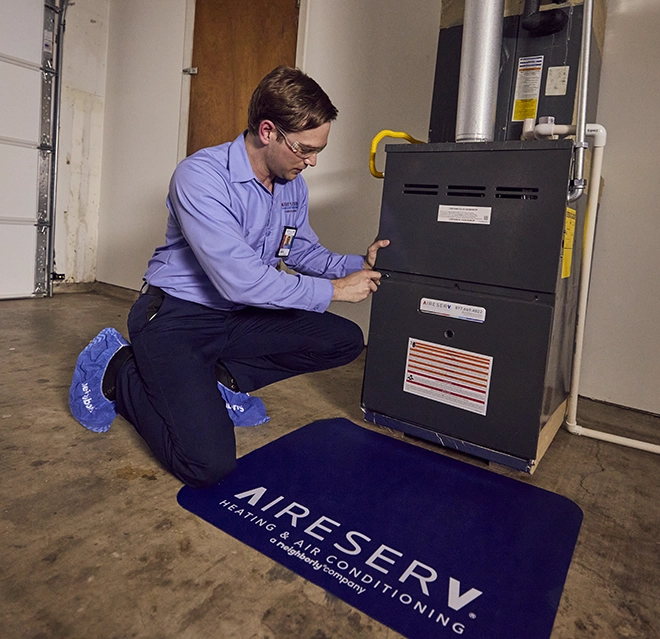
A furnace maintenance visit includes verifying combustion, inspecting the heat exchanger for cracking, checking venting and draft, testing every safety control, confirming manifold pressure against the rating plate, and inspecting the burners. None of that is visible from outside the cabinet.
In this region the risk is elevated for a specific reason. A furnace here runs a handful of times a year. Problems develop during nine or ten months of dormancy, and the first firing of the season is when they surface. That first firing is the moment you want to have already been inspected.
Fall maintenance is included in both the Advantage Plan and the Coastal Advantage Plan. If you run a furnace and you are not on a plan, at minimum have it inspected annually before the season.
Related Services
- Heating and furnace installation when replacement is the answer
- Heat pump repair for the systems most homes here actually run
- Emergency HVAC service for no-heat situations during a freeze
- Thermostat installation and repair for staging and control faults
- Duct sealing and air filters for airflow problems behind limit trips
- Advantage Plan whose fall visit covers combustion safety
Written by the team at Aire Serv of Northwest Florida.
Technically reviewed by Justin B., NATE-certified and EPA 608 certified, 19 years in the trade.
Reviewed for accuracy by owner Justin Sonntag, a 26-year Gulf Coast resident.
Florida Certified Air Conditioning Contractor, license CAC1823566.
Last reviewed: August 2026
Questions about your system? Call or book online in about a minute.